

Rumble Rummy Basics: A Beginner’s Guide to Playing Online
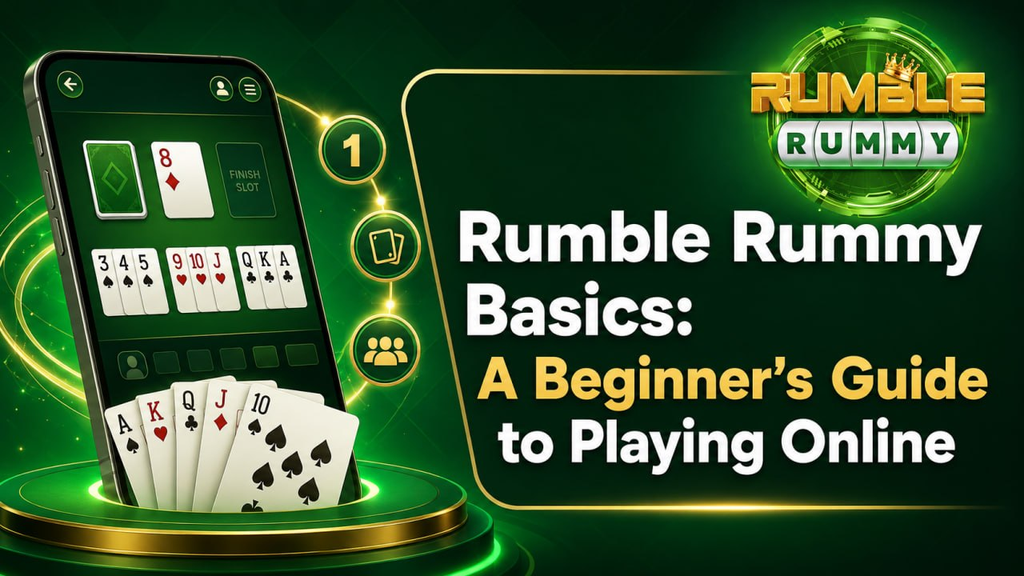
At first, Rummy seems difficult when you look at a hand of 13 cards since you have to sort them, make groups and keep an eye on each move. The good thing is that the basic rules are easy to learn.
The guide for beginners shows how rummy functions. You’ll be taught the rules regarding sets, sequences, jokers, drawing cards, and making a valid declaration. It also includes some simple tips which can help you steer clear of common mistakes.
What Is Rumble Rummy?
Rumble Rummy is a mobile gaming platform designed for use on Android devices and features games such as Indian Rummy, Poker, Ludo, slots, tournaments, and rewards; nevertheless, this guide is concerned only with the basic rules of Indian Rummy.
By using an app you don’t need a physical set of cards since the programme deals the cards, takes charge of each turn and verifies the final hand. However, you still have to know the rules and decide on how to arrange your cards.
What Is the Goal of Rummy?
The primary objective is to organize all the cards in your hand into valid sequences and sets; a sequence consists of cards in order all of the same suit, and a set includes cards of the same rank but with different suits.
To make a valid declaration, you normally need at least two sequences. One of them must be a pure sequence. You must complete your hand before the other players. Once every card belongs to a valid group, you can declare your hand.
Basic Rummy Rules for Beginners
Indian Rummy is usually played with 13 cards for each player. The remaining cards form a closed pile, so players cannot see them before drawing. Place one card face up to start the open pile.
On each turn, draw one card from either pile and discard one card you do not need. Keep arranging your cards into valid sets and sequences. The round ends when a player makes a valid declaration. Rules may change by game mode, so read them before you start.ste
Understanding Sets and Sequences
Sets and sequences are the two types of groups used in rummy. Every card in your completed hand must belong to one of these groups.
What Is a Sequence?
A sequence is a group of three or more cards in order from the same suit.
Examples include:
- 3♥, 4♥ and 5♥
- 8♣, 9♣ and 10♣
- J♠, Q♠ and K♠
The cards must be from the same suit. For example, 5♦, 6♣ and 7♦ do not form a sequence because the suits are different.
The cards must also follow the correct order. A missing card will make the sequence incomplete unless an allowed joker fills its place.
What Is a Set?
A set contains three or four cards of the same rank in different suits.
Examples include:
- 6♥, 6♣ and 6♠
- Q♦, Q♥, Q♣ and Q♠
A set cannot contain the same suit more than once. Two 6♥ cards cannot be used together in the same set, even when the game uses more than one deck.
What Is a Pure Sequence?
A pure sequence contains at least three cards in order from the same suit. It does not use a joker to replace a missing card.
For example:
- 4♠, 5♠ and 6♠
- 9♦, 10♦, J♦ and Q♦
A pure sequence is one of the most important parts of a rummy hand. A player normally cannot make a valid declaration without it.
Try to form your pure sequence early. Look for connected cards from the same suit. A pair such as 5♣ and 6♣ is useful because either 4♣ or 7♣ can complete the sequence.
What Is an Impure Sequence?
An impure sequence uses a joker to replace a missing card.
Suppose you have 7♥ and 9♥. You need 8♥ to complete the group. If you use a joker in place of 8♥, the group becomes an impure sequence.
An impure sequence is still a useful card group. However, it cannot replace the pure sequence required for a valid declaration.
This difference can confuse new players. Before declaring, check whether your main sequence uses a joker as a replacement.
How Do Jokers Work?
A joker is a flexible card that can replace a missing card in certain sets or sequences.
For example, you may have:
- 10♣, J♣ and a joker
- 8♦, 8♠ and a joker
In the first group, the joker may act as Q♣. In the second group, it may replace another card with the rank of eight.
A game may include printed jokers and wild jokers. A wild joker is a card rank chosen at the start of the round. If five is selected, all fives may act as jokers under the game rules.
Use jokers with care. They are often most helpful for groups that would otherwise be hard to complete. Do not use one as a substitute in your required pure sequence.
How to Play Rummy Online
After the cards are dealt, begin by sorting your hand. Place cards of the same suit together. This makes possible sequences easier to see.
A normal turn works like this:
- Look at the top card of the open pile.
- Decide whether it can improve your hand.
- Draw from the open pile or closed pile.
- Add the card to a possible group.
- Select one card you no longer need.
- Place that card in the discard pile.
You should always finish your turn by discarding one card. This keeps the correct number of cards in your hand.
Continue improving your groups with each turn. Watch which cards other players pick and discard. Their actions may give you clues about the groups they are building.
How to Make a Valid Declaration
A valid declaration means arranging every card into correct sets and sequences while meeting the main rules of the game.
A valid hand commonly needs:
- At least two sequences
- At least one pure sequence
- Valid sets or sequences for all remaining cards
- No unused card outside a group
Imagine that your hand contains these four groups:
- 3♥, 4♥ and 5♥ — pure sequence
- 7♣, 8♣, a joker and 10♣ — impure sequence
- K♥, K♣ and K♠ — set
- 2♦, 2♥ and 2♣ — set
This hand has a pure sequence, a second sequence, and two valid sets. It may qualify as a valid declaration under standard rules.
Check every card before you declare. A wrong suit, missing card, or repeated suit in a set can make the hand invalid.
Simple Rummy Strategies for Beginners
Start by making a pure sequence, since it is required for a valid hand. Keep cards that can connect in more than one way. For example, 6♠ and 7♠ can join with either 5♠ or 8♠. Remove cards that do not match the rest of your hand.
Watch the open pile and notice which cards other players take. This may help you understand what they are building. Avoid discarding cards that could help them. Remember that no strategy can guarantee a win because every round depends on the cards dealt and drawn.
Common Beginner Mistakes to Avoid
New players often rush to complete their card groups and miss important rules. Learning these common mistakes can help you arrange your hand correctly and make a valid declaration.
- Building no pure sequence
- Mixing different suits in a sequence
- Using the same suit twice in a set
- Keeping unrelated cards for too long
- Using jokers without a clear need
- Ignoring other players’ moves
- Declaring before checking every group
Tips for Responsible Play
Consider playing online rummy as a form of entertainment. Before you begin, decide on the amount of time you’ll spend and take frequent breaks. If there is an entry fee for a game, establish a strict limit on how much you can spend. Never use money which is required for food, rent, bills, or other essential needs. Avoid continuing to play in order to get back the amount you had lost previously.
Cash-based games are available exclusively to adults who are of the legal age. Laws can differ from one place to another. So, please check the local regulations as well as the platform’s terms before taking part.
Final Thoughts
The basic principles of Rumble Rummy are simple when you know how the card groups function. You have to draw one card, get rid of one card, and make valid sets and sequences. Generally, a valid declaration must include at least two sequences, one of which has to be a pure sequence.
Beginners should learn the basic rules before trying advanced tactics. Sort your cards, build a pure sequence early, and use jokers wisely. Always check every group before declaring. With practice, you can understand your hand better and make smarter choices.