

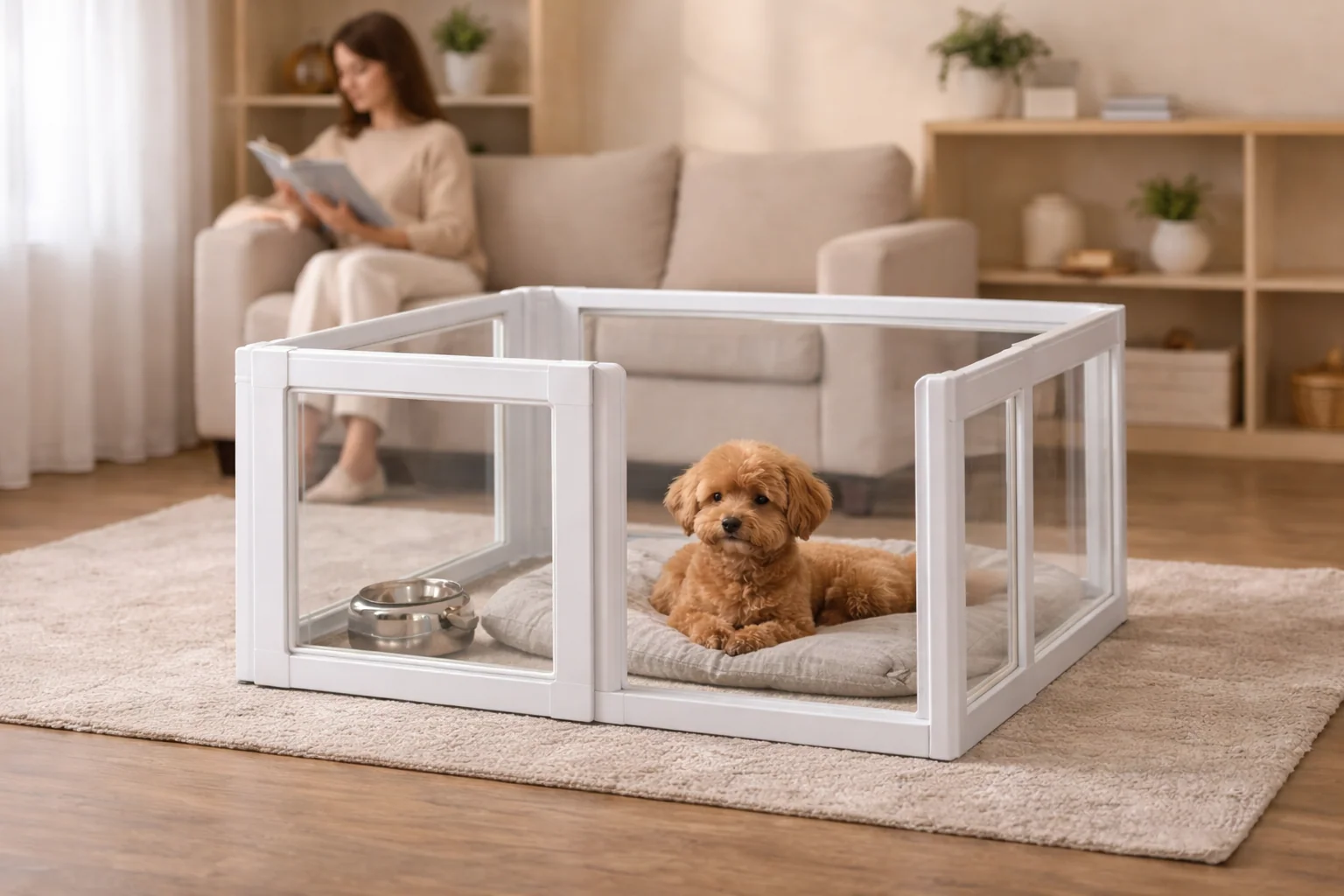
The panels of a dog kennel playpen are the easy decision, and everything around them is what determines whether the dog settles
A run is a place before it is a product
Australian households set up outdoor runs as winter ends and dogs start spending real time outside again. A dog kennel playpen roughly three metres square arrives as a box of panels, and almost every question that decides whether it works well is about the ground it is going onto.
Owners spend their research on the dog kennel playpen itself and almost none on the site. That is understandable, since the panels are what gets bought, and it is the wrong way round, because a well made run in a poor position is a poor run.
Shade has to move through the day, not exist at noon
The sun crosses a large arc over a dog kennel playpen between morning and evening, and a patch of shade at midday can be full sun by three o’clock. Anywhere a dog will spend a whole day needs cover that works across the entire afternoon rather than at the moment the owner checked.
Deciduous trees are the trap here. A run positioned under bare branches at the end of winter looks well shaded once the canopy fills in, and one positioned under summer foliage turns out to be fully exposed by the following August.
Where nothing grows, shade has to be built. A cloth panel over part of the run rather than all of it gives the dog a choice, which matters in late winter when the same animal that hid from the sun in February will lie in it for hours.
Water finds the run before it finds anywhere else
Ground that puddles after rain will puddle inside a dog kennel playpen, and a dog confined there has no way to avoid it. The place to check is not the enclosure but the paddock or lawn around it, and the time to check is during the wettest week of the year.
Slight elevation solves most of it. Siting the run on the higher part of a yard, or building the pad up a hundred millimetres above the surrounding ground, keeps the surface draining outward instead of collecting whatever runs off the roof and the driveway.
What sits uphill deserves a look as well. A run below a driveway, a shed roof, or a downpipe receives everything those surfaces shed, and a downpipe discharging a few metres away will find its way into the enclosure within one storm.
The surface underneath is a choice with no clean winner
Grass under a dog kennel playpen looks best and lasts least. A dog patrolling the same perimeter kills the turf along the fence within weeks, and what remains is bare soil that turns to mud in winter and dust in summer, which is why grass suits occasional use rather than daily confinement.
Gravel drains beautifully and washes down easily, and some dogs dislike standing on it for long periods. Fine crushed material is kinder to feet than coarse aggregate, and it needs topping up as it gradually works into the ground beneath.
Concrete is the practical answer with an obvious cost
A slab hoses clean, cannot be dug through, and lasts indefinitely, which is why boarding facilities use it. It is also hard on joints and holds heat well into the evening after a hot day, so it wants a bedded area and shade to be humane.
Distance from the house cuts both ways
A run close to the back door gets visited more often, and a dog that can see its household is calmer than one that cannot. The same closeness means every bark arrives in the kitchen, which is either a useful alert or the end of a quiet evening.
Neighbours experience it differently again. Placing a run against a shared boundary puts a dog’s attention on whatever happens on the other side, and much of the barking that owners describe as constant is a response to movement a few metres away.
A bored dog works on the enclosure
Digging at corners, chewing at panel joints, and pacing the fence line are all signs of an animal with nothing else to do rather than of an enclosure that is too weak. Adding occupation is usually more effective than adding steel.
Chew items, a raised platform to lie on, and a view of something interesting take up most of that energy. The platform earns its place twice over, since it keeps the dog off wet ground and gives it the elevated position dogs choose whenever they are offered one.
What the dog can see is part of the same question. A solid panel or a screen along the boundary side removes the traffic that sets off most barking, while leaving the house side open so the animal can still watch what matters to it.
The daily routine should be designed, not discovered
Food and water sit where they can be reached inside a dog kennel playpen without the dog crowding the gate. Waste collects nearest the gate, which is where the shovel and the bin should be, and none of that should require anyone to walk the length of the run twice a day carrying something.
Water needs its own thought in summer. A bowl in full sun is warm by midday and empty by evening if it gets knocked, so a shaded position and a container heavy enough to stay upright are worth more than any amount of capacity.
Ground surfaces divide by what they cost you
•Grass: comfortable, gone within a month
•Gravel: drains and rinses, hard on some feet
•Concrete: permanent and hygienic, needs bedding
Where careful siting pays and where it cannot help
•Strength: a dry shaded run gets used willingly
•Strength: good drainage removes most cleaning
•Limit: no position fixes a dog left alone all day
•Limit: prepared surfaces cost more than the panels
Weighed against putting the run wherever there is room, a prepared site costs a weekend and returns an enclosure that works in every season. An owner near Toowoomba moved hers twice before settling on the high side of the shed, which was where the shade fell all afternoon.
Animal housing is being planned rather than assembled
Owners increasingly treat an outdoor run as a small piece of construction, with drainage, surface, and shade decided before anything is ordered, which is a change from buying panels first and finding somewhere to put them afterwards.
That way of approaching the job is why the animal housing TMG Industrial supplies is built as panels that can be set out on whatever surface an owner has prepared rather than as a fixed structure.